

Share this
by Edge Dairy Farmer Cooperative on Sep 25, 2026, 1:51:31 PM
For dairy farmers, managing a growing operation requires balancing countless responsibilities. Between caring for cattle, managing employees, maintaining equipment and producing high-quality milk, finding time to navigate a complex permitting process can be overwhelming.
That's exactly why the Maestro Permitting Program, powered by the Voice of Milk and available as a membership benefit through Edge Dairy Farmer Cooperative and the Dairy Business Association, was created.
The program helps farms navigate the often-complicated process of obtaining and maintaining a Concentrated Animal Feeding Operation (CAFO) permit by providing expert guidance, trusted industry connections, technology-driven compliance tracking and ongoing support.
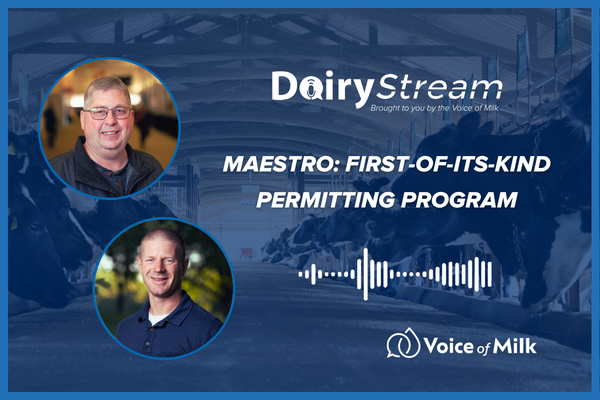
On a recent Dairy Stream episode, host Joanna Guza spoke with Tim Baumgartner, Chief Financial and Regulatory Officer for Edge Dairy Farmer Cooperative, and Rick Roden, owner of Roden Echo Valley Farm in Washington County, Wis., about how Maestro helps farmers tackle permitting challenges.
Why Maestro was created
According to Baumgartner, the concept for a permitting assistance program had been discussed within Edge and DBA for years. Farmers consistently expressed a need for support navigating the regulatory requirements associated with permitting.
"The permitting process involves many moving parts," Baumgartner explained. "There are engineers, nutrient management planners, regulators, timelines, reports and compliance requirements. Bringing all those pieces together can be a significant undertaking."
Many farms, especially those preparing to expand beyond 1,000 animal units, may not have all the necessary professional relationships already in place. Others may need to establish new partnerships as long-time consultants and service providers retire from the industry.
Maestro was designed to serve as a central coordinator, helping farms assemble the right team and keep projects moving forward.
Understanding the complexity of permitting
Obtaining a permit is not a quick process. In fact, Baumgartner estimates that a first-time permit applicant can expect the process to take anywhere from 18 to 24 months from initial application to permit approval.
Several factors contribute to that timeline:
- Engineering plans must be developed and reviewed.
- Nutrient management plans must meet specific requirements.
- Existing facilities may need assessments or upgrades.
- Multiple reports and applications must be submitted.
- State agency reviews often occur within specific regulatory timelines.
"The timeline is probably the hardest thing to map," Baumgartner said. "You have to coordinate with contractors, consultants, regulators and farm growth plans all at the same time."
For farmers who are simultaneously running a dairy operation, staying organized can become a challenge.
Connecting farmers with trusted experts
One of Maestro's key benefits is helping connect farms with experienced professionals. Agricultural engineering and nutrient management planning are highly specialized fields, and not every consultant has experience with permitting requirements.
Maestro helps match farms with professionals who fit their needs, considering factors such as:
- Expertise
- Geographic proximity
- Capacity for new projects
- Compatibility with the farm's management style
Baumgartner emphasized that Maestro does not replace existing relationships.
"If a farm already has an engineer or nutrient management planner they trust, we'll absolutely work with them," he said. "Our goal is to enhance those relationships and help everyone work together effectively."
For Roden Echo Valley Farm, that collaborative approach proved valuable.
"We already had an engineer and a comprehensive nutrient management plan," Roden said. "But Tim helped bridge the gap between us, the DNR, the engineer and other service providers, while keeping everyone on track."
Staying organized through technology
A unique feature of Maestro is its proprietary compliance management platform. The system was designed to mirror the entire permitting and compliance cycle, allowing farms and their service providers to stay ahead of deadlines and reporting requirements.
The platform automatically sends reminders for critical tasks such as:
- Annual reports
- Nutrient management updates
- Manure sampling requirements
- Permit renewal deadlines
- Facility inspections and assessments
Rather than relying on spreadsheets or calendar reminders, the system generates notifications directly to the individuals responsible for completing specific tasks.
For Roden, those reminders have become an important part of maintaining compliance.
"Sometimes you open the email and think, 'Didn't we already do this?'" Roden said with a laugh. "But if something got missed or forgotten, those reminders are really valuable."
Helping farmers navigate relationships
Another major advantage of the Maestro program is its strong connection to regulatory agencies.
Baumgartner regularly works with Department of Natural Resources (DNR) staff at both local and state levels and understands the agency's internal structure and processes.
Because agency personnel can change over time, maintaining those relationships helps ensure farms know who to contact when questions arise.
"I might know one or two people at the DNR," Roden said. "Tim knows the whole system and knows who to go to for answers."
Ongoing support beyond the permit
The value of Maestro does not end once a permit is approved. CAFO permits must be maintained, monitored and eventually renewed. Compliance responsibilities continue throughout the life of the permit.
Maestro helps farms stay ahead of those requirements through:
- Automated compliance tracking
- Annual reporting reminders
- Ongoing regulatory communication
- Permit renewal planning
- Coordination with service providers
"No one wants to receive a letter saying they're out of compliance," Baumgartner said. "Our goal is to make sure those important items don't fall through the cracks."
How farmers can get started
For farms interested in the Maestro program, the first step is a conversation and on-farm assessment.
Baumgartner works with farms to evaluate:
- Current operations
- Existing permits and plans
- Future growth goals
- Compliance needs
- Professional support teams
From there, Maestro develops a customized roadmap based on where the farm is in its permitting journey. Whether a farm is exploring expansion, actively planning an expansion or simply looking for help managing compliance requirements, the program is designed to provide practical guidance every step of the way.
The bottom line
The permitting process can be complex, time-consuming and difficult to navigate alone. Through the Maestro Permitting Program, farmers have a trusted resource that helps them connect with experts, stay compliant, manage timelines and maintain productive relationships with regulators.
As Roden summed it up: "There are cattle and land to care for every day. All the little permitting things that need to be done aren't always at the top of my mind. That's why having those reminders and that extra support is so helpful."
For dairy farmers focused on growth and long-term success, Maestro offers a streamlined path through one of agriculture's most complicated regulatory processes.