Share this
by Edge Dairy Farmer Cooperative on Nov 20, 2026, 11:00:40 AM
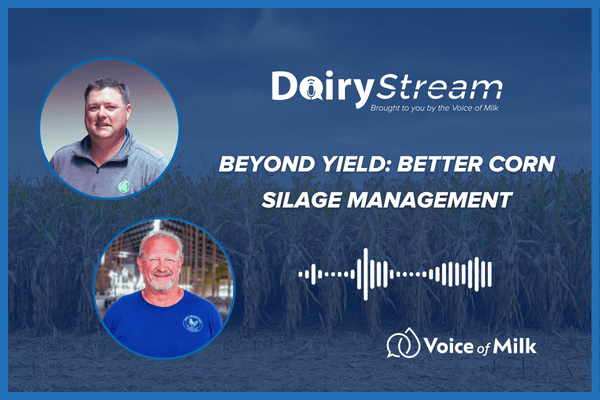
Corn silage harvest may be complete, but the work of evaluating this year’s crop and preparing for next season is just beginning. On a recent Dairy Stream episode, forage specialist Mike Kabat of Prairie Estates Genetics and Wisconsin dairy farmer Jeff Opitz of Rockland Dairy shared insights from the 2026 growing season, discussed common storage management mistakes and outlined strategies for producing high-quality feed in an increasingly unpredictable environment.
A growing season defined by weather extremes
The 2026 season started with relatively timely planting across much of Wisconsin and the Upper Midwest. However, weather conditions quickly became variable.
According to Kabat, many farms experienced a wet June followed by a dry July, creating challenges during pollination and starch development. Fortunately, late-summer rains helped many crops recover.
"The rain returning in August really saved the crop in a lot of areas," Kabat explained.
Opitz saw those weather swings firsthand. While Rockland Dairy experienced delayed planting due to heavy April rainfall, timely rains later in the season helped maintain strong yields.
"We were fortunate," said Opitz. "We got rain when we needed it, and overall, it turned out to be a very good crop."
One notable trend across the region was that corn ears often matured faster than the plants themselves. As a result, many farms harvested silage with higher starch levels and more advanced kernel development than expected.
What factors affected silage quality?
While overall crop health remained strong through much of the growing season, grain fill and starch development became critical management considerations during the summer drought.
Kabat emphasized the importance of evaluating ear development relative to plant size to ensure adequate starch content in the final feed.
Fungicide use also became a major topic of discussion in late summer. Because disease pressure remained relatively low early in the season, some producers questioned whether fungicide applications were necessary. However, late-season disease outbreaks reinforced the value of protecting plant health through harvest.
Common mistakes from the field to storage
Successful silage production doesn't end when the crop is chopped. Both Kabat and Opitz emphasized that attention to detail during harvest and storage can have a significant impact on feed quality and shrink losses.
Key areas to monitor include:
Kernel processing
Modern harvest equipment does an excellent job processing kernels, but operators still need to ensure kernels are adequately broken to maximize starch availability.
Length of cut
As crops become drier, shortening the theoretical length of cut can improve packing density and fermentation.
Many nutritionists recommend reducing chop length to approximately one-half inch when moisture levels decline.
Packing density
Insufficient packing remains one of the most common storage mistakes.
"You need enough iron on the pile," Opitz said.
Thin layers, adequate tractor weight, and careful packing help eliminate oxygen and support proper fermentation.
Cleanliness matters
Kabat highlighted an often-overlooked detail: keeping packing tractor tires clean. Driving through gravel, soil or silage effluent before heading back onto the pile can introduce undesirable microorganisms that negatively affect fermentation.
Three keys to better silage storage
When asked to identify the most important storage management priorities, Kabat narrowed the list to three essentials:
1. Pack aggressively
Removing oxygen as quickly as possible is the foundation of successful fermentation. Ideally, oxygen should be eliminated within the first 12 to 24 hours through proper packing and microbial activity.
2. Cover properly
Using oxygen-barrier films and sealing bunker walls can dramatically reduce spoilage and shrink.
Opitz noted that his team focuses heavily on creating smooth bunker surfaces before covering, allowing plastic to make tight contact with the feed.
3. Prioritize fermentation
Using inoculants and monitoring fermentation results helps preserve feed quality and improve stability throughout the storage period.
"Oxygen is the enemy," Kabat said. "The faster we can get it out, the faster fermentation can preserve that feed."
Don't wait until feeding to test feed quality
Many farms test silage after fermentation, but Prairie Estates Genetics takes a more proactive approach.
Kabat explained that his team collects forage samples as silage enters storage to evaluate:
- Starch content
- Fiber levels
- Digestibility
- Kernel processing scores
- Particle size distribution
This information helps producers anticipate diet adjustments and evaluate hybrid performance long before new-crop silage reaches the feed bunk.
"The more data we collect on the front end, the more we can help farms make a smooth transition into new crop," Kabat said.
Looking beyond yield when selecting hybrids
As farmers begin planning for next season, Kabat encourages producers to evaluate more than just tonnage.
Instead of focusing strictly on bushels or tons per acre, he recommends measuring success through digestible nutrients per acre.
"We don't just want a big pile of feed," he said. "We want feed that cows can actually utilize."
That philosophy extends to seed selection as well. Rather than making drastic changes based on a single season, Kabat recommends taking a long-term view and analyzing multiple years of data before significantly changing hybrid programs.
Managing through unpredictable weather
If the last several years have shown anything, it's that no two growing seasons are alike. Kabat noted that weather variability has increased dramatically, making adaptability more important than ever.
His recommendation is to focus on stable, widely adaptable genetics that perform consistently across soil types and growing conditions rather than chasing a "home run" hybrid designed for a specific environment.
Opitz agrees that management fundamentals remain the strongest defense against weather uncertainty.
His priorities include:
- Maintaining strong crop rotations
- Matching hybrids to soil types
- Avoiding rushed planting conditions
- Prioritizing seedbed quality
- Managing harvest timing carefully
"If you dot all your i's, Mother Nature can throw a lot at you, and you're still going to have a halfway decent crop," Opitz said.
The bottom-line connection: Feed efficiency
Ultimately, silage quality is directly connected to farm profitability. Kabat encourages producers to balance yield and quality rather than maximizing one at the expense of the other.
High-quality forage allows cows to consume more digestible nutrients from homegrown feed, improving feed efficiency and helping control purchased feed costs.
The goal is not simply growing more tons. The goal is growing more usable nutrients per acre.
What's next in the silage world?
One emerging topic generating significant industry discussion is the transition away from BMR corn hybrids and the growing interest in short-stature corn. Both Kabat and Opitz are cautiously evaluating the technology.
While short corn has generated considerable buzz, both noted questions remain about yield potential, harvestability and its ability to perform under drought conditions.
"We're trying to learn more about it," Kabat said. "There are still a lot of questions that need answers."
For now, both believe strong genetics, sound agronomic practices and disciplined harvest management remain the most reliable path to producing high-quality forage.
Final takeaway
The 2026 corn silage season reinforced a simple but important lesson: successful forage production comes down to management.
From hybrid selection and planting decisions to harvest timing, packing, fermentation and feed testing, every step plays a role in determining the quality of feed that ultimately reaches the cow.
While farmers can't control the weather, they can control how they respond to it. As Kabat noted, dairy producers have consistently proven their ability to adapt, refine their management practices and continue producing high-quality feed regardless of what Mother Nature delivers.